
|
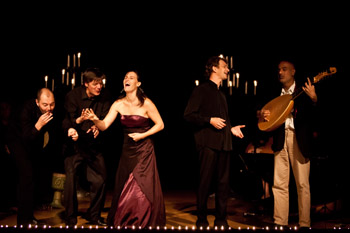
Le Poème Harmonique, a group of soloists who came together in 1998 under the direction of Vincent Dumestre, centers its artistic activity on music of the seventeenth and the early eighteenth century. They have exhilarated audiences from the Concertgebouw in Amsterdam, Theatre de Champs- Elysees in Paris and St. Petersburg Philharmonic Hall to Boston Early Music Festival, Miller Theatre and Cal Performances. “This is total art, refined in the extreme, and wonderfully alive.” —Le Monde (Palais des Beaux-Arts) “…A four-hour performance, almost every minute of it fascinating, a celebration, a challenge taken up with as much skill as pleasure, that resolutely turns its back on dry-as-dust theatrical archaeology… ” —Le Soir (Belgium) |
Formed in 1998, Le Poème Harmonique is a group of soloists, gathered around its artistic director Vincent Dumestre. Its artistic activity, centred on vocal and instrumental music of the seventeenth and early eighteenth century, is regularly enriched by interaction with other disciplines. This, together with real teamwork – working together as a company – is Le Poème Harmonique’s hallmark in Baroque performance today.
Actors, dancers, circus artists and puppeteers join its singers and musicians in programmes of chamber works – Le Ballet des Fées, Il Fasolo – and, since 2004, in large-scale stage productions, such as Le Bourgeois Gentilhomme (a comédie-ballet by Molière and Lully; stage director Benjamin Lazar) and Baroque Carnival (directed by Cécile Roussat). For operatic performances, such as Lully’s Cadmus et Hermione and Cavalli’s Egisto (both staged by Benjamin Lazar), Le Poème Harmonique studies in depth the correspondences between ‘period’ aesthetics – use of candles for lighting, authentic gestures and painted sets and machinery – and the aesthetics of modern stage productions. The ensemble also gets back to the sources of early French and Italian music by exploring its relationships with traditional or folk music. The recording entitled Aux Marches du Palais, for instance, is devoted to French songs of oral tradition.
Twenty-five per cent of Le Poème Harmonique’s activity takes place in the Haute-Normandie Region. But since it was founded the ensemble has made many concert tours in Europe and has appeared in most of the continent’s capitals, with recent debuts including London, Vienna and Madrid. It has a particularly strong rapport with audiences in Rome, New York and Tokyo.
Outstanding events of the past seasons include Le Bourgeois Gentilhomme, Baroque Carnival and Cadmus et Hermione, all of which have been exceptionally successful, with almost 130 performances, at venues including the Opéra Comique, Théâtre des Champs-Elysées and Cité de la Musique in Paris, the Opéra de Rouen Haute-Normandie, Théâtre de Caen, Grand Théâtre de Provence at Aix-en-Provence, Grand Théâtre de Luxembourg, the Utrecht Festival, Teatro Canal in Madrid, Teatro San Carlo in Naples, the National Theatre in Prague, the Budapest Spring Festival, San Francisco Cal Performances Festival, and so on.
The ensemble’s recent stage projects have included the first performances of Pagliardi’s Caligula, in September 2011 at the International Puppet Festival in Charleville-Mézières, and of Cavalli’s Egisto, in February 2012 at the Opéra-Comique in Paris, then at the Opéra de Rouen Haute-Normandie. Also, in 2013-2014, as part of its residency there, Le Poème Harmonique will be presenting Purcell’s Dido and Æneas at Rouen Opéra. In 2014-2015, again with the Opéra-Comique and Rouen Opéra, the ensemble will be performing Le Malade imaginaire, the play by Molière, with music by Charpentier.
The ensemble’s recordings for the Alpha label have met with rare public success (over 150,000 CDs and DVDs sold since 1998) and also with great critical acclaim. Le Poème Harmonique has received the Grand Prix de l’Académie Charles Cros, the Diapason d’Or (including Best DVD of 2006 for Le Bourgeois Gentilhomme), recommendations from Opéra International, Classica, Le Monde de la Musique, a Prelude Classical Award in 2003, the Antonio Vivaldi International Award (Cini Foundation, Venice), the Caecilia Press Prize, and so on. The DVD of Cadmus et Hermione, released in 2008, was also exceptionally well received (Diapason d’Or, Recommended by Classica, BBC Music Choice, German Record Critics’ Award, etc.).
“Vincent Dumestre is back with a program that touches heart and soul alike with its pure polyphonies, delicate, inspired ornamentation, its interiorized ductility of musical language, its vocal clarity and skilfully emphasized harmonic friction. Working with an equally inspired Claire Lefilliâtre…, Dumestre has assembled a top-flight group of vocal performers … while his consort of viols is quite simply sublime.”
—Stéphan Perreau, Classica
“This is total art, refined in the extreme, and wonderfully alive.”
—Marie-Aude Roux, Le Monde
(Cadmus et Hermione, Théâtre National de l'Opéra Comique)
“...the audience was simply giving a standing ovation, loud, bright, warm and sincere, to one of the most delightful shows that has been given in an opera house for a long time. A show from which one emerges on cloud nine, and having not missed a single word – which is rare.”
—Gaëtan Naulleau, Diapason
(Cadmus et Hermione, Théâtre National de l'Opéra Comique, Paris)
“Vincent Dumestre, the ensemble’s music director, led his singers and a viol consort with organ and theorbo in a gripping, beautifully shaped account.”
—Allan Kozinn, New York Times
(Lamentations d’Emilio de’ Cavalieri, Miller Theatre, New York)
“And it truly was an event: This congregation of performers was having a spiritual moment onstage, an experience in which we counted ourselves lucky to take part.”
—Olivia Giovetti, TimeOut New York
(Lamentations d’Emilio de’ Cavalieri, Miller Theatre, New York)
“Recorded a month after a thrilling concert giving at the Louis XIII festival at the Centre de Musique Baroque in Versailles, this CD recaptures the same magic. The spellbinding vocal polyphony and unhurried phrasing of the instruments confirm the virtuosity of the Poème Harmonique...
—Philippe Venturini, Le Monde de la Musique, CHOC
(CD Je Meurs sans mourir)
“Fittingly-named Poème Harmonique! We can only marvel …. Vincent Dumestre and his partners have put together a skillfully crafted program, whose thousand and one details enthrall. The instrumental accompaniment is quite simply exceptional. While the lute and guitar illuminations of Vincent Dumestre can only be compared with the masterworks of the greatest goldsmiths, the consort of viols especially elicits astonishment for its ensemble perfection.… A glowing recording.” (Zurich Tonhalle)
—Répertoire, R10
“... If Belli's astounding music has been so powerfully resurrected it is also thanks to an instrumental performance featuring viols, triple harp, percussion, theorbo and guitar exemplary in its precision and miraculous in its beauty. The most attentive care is lavished on the slightest introduction and we marvel continually, here at a discrete stroke of percussion, there at a figure played on the theorbo.… The sound engineering is dazzlingly natural, showing off every change of timbre and nuance on this remarkable recording.”
—Le Monde de la Musique, CHOC
“...A four-hour performance, almost every minute of it fascinating, a celebration, a challenge taken up with as much skill as pleasure, that resolutely turns its back on dry-as-dust theatrical archaeology.… The band is as tight-knit and multi-skilled as the various art forms are seamlessly entwined in a delightful, subtle, baroque rhetoric…. The singers deserve the utmost praise... Without ever hogging the limelight, Dumestre works himself easily into each of the interludes – one more asset in the harmonious combination of the arts that has helped this Bourgeois Gentilhomme to triumph in Brussels.”
—Michèle Friche, Le Soir (Belgium)
(Palais des Beaux-Arts)
“Four years ago, conductor Vincent Dumestre and stage director Benjamin Lazar brought us a Bourgeois Gentilhomme that revolutionized the approach to the comédie-ballet. They have now done it again at the Opéra-Comique with a staging of Lully's Cadmus et Hermione.… The beauty of the orchestra is impressive, combining as it does viols, theorbos and bagpipes with the strong chorus. The limpid management of space and candlelit staging add to the perfection. Twenty years after Atys by William Christie and Jean-Marie Villégier at this same venue, Cadmus et Hermione is a milestone for its stylistic choices, starting with the use of period French that pronounces the final "e". During a performance lasting two and a quarter hours, the troupe surpasses itself, to the point that we cannot praise the exquisite Hermione – the daughter of Mars and Venus – sung by Claire Lefilliâtre, more than André Morsch's Cadmus, Prince of Tyr, Arnaud Marzorati's Arbas, Isabelle Druet's Charity or the Nurse, sung by counter-tenor Jean-François Lombard.”
—Libération
Matthew-Murphy.jpg)
5066x3378 pixel JPG (300dpi), 2.5 MB
olivier.lexa.jpg)
olivier.lexa.jpg)
3456x2592 pixel JPG (180dpi), 2.4 MB
Monteverdi, Manelli - Venezia, dalle calli ai palazzi
Baroque Carnival
Baroque Limelight
Monteverdi - Lamento della ninfa
(Performance for ‘Victoires de la Musique,’
the Academy Awards of classical music in France)
Audio:
Le Poème Harmonique at BBC Proms Cadogan Hall
VENEZIA dalle strade ai palazzo -‘From the Streets to the Palaces’
…a celebration by candlelight of Venice in the Golden Age of Baroque, when art music and popular forms came together and mingled, and feelings and freedom of language had not yet been restrained by rules and codes.
…music of Claudio Monteverdi, Biagio Marini, Francesco Manelli and Benedetto Ferrari.
Claire Lefilliâtre, soprano
Jan Van Elsacker, tenor
Serge Goubioud, tenor
Arnaud Marzorati, bass
Johannes Frisch, violin
Lucas Guimaraes, treble and bass viol
Françoise Enock, violone
Joël Grare, percussion
Jean-Luc Tamby, colascione and guitar
Vincent Dumestre, theorbo, baroque guitar and direction
Mise en geste : Benjamin Lazar
Programs (PDF)
Baroque Limelight
Monteverdi & Manelli
Comabttimenti
Carnaval Baroque.